Most think of Sales & Operations Planning as the way to make cross-functional decisions and roll-up plans for internal downward management, and while this is true and critical, it’s not the only reason why effective leaders use it. Leaders with the true process also use it to coordinate and manage upward to the corporate and board or investor levels. By the true process, I mean the executive monthly aggregate level process as opposed to some tactical, order-level, demand and supply discussion led by a manager, that is often wrongly called S&OP. The latter will do very little to address what is discussed in this article. Leaders that don’t have a real executive level process will spend more time on corporate reporting requirements, preparation for reviews, and answering questions from Head Office.
Over many years and projects, Nexview has helped several regional and business unit leaders, not only to improve their businesses, but also to use the process to get out in front of the needed inputs and questions coming from Corporate or investors. We’ve seen what follows in this article many times. While not entirely correct, I will use the terms “regional” and “business unit” interchangeably for simplicity to refer to a corporate parent/child relationship for multi-level S&OP. We know there are differences in the terms and of course business units often have regions within them. We usually find most gaps in the older regional structures where the regions have grown beyond sales offices to include operations and assets. In the case of global business units, they are often times more mature in S&OP, see Part 2 for this case.
This article is for leaders who lack true S&OP and have to be the bridges between the tactical local process and the required Corporate inputs. Please read on if you:
While the questions and inputs needed by Corporate are usually justified, the root cause of the wasted time and effort is avoidable. The standard questions are ubiquitous:
Good luck too if you get behind on plan. Then you get “help” through even more frequent checks and requests. Geographical and time zone differences complicate this further with time lags and meetings at inconvenient times (usually at night after an already long day for those in Asia). Arghh.
Without spending any time on the merits and gaps of the holding company/conglomerate structure, I’ll just say that when the dealmakers and lawyers put it together or built onto it, a corporate S&OP that rolls down to the regions or business units usually doesn’t come up in the discussion. In these cases, something at the corporate level is set up for planning and reporting that is usually driven by the central finance group. I’m not saying that a full Global S&OP is always needed (e.g. especially for essentially a holding company), but the corporate requirements typically would not consider your S&OP process or calendar.
The Managing Director/regional leader is given the mandate of what’s required by when and is one of many inputs across the global enterprise. The regional leader often has been a very successful commercial leader and S&OP or anything operations just hasn’t been his/her emphasis. These “details” then get relegated to a Supply Chain Manager (or maybe a Director) who deals with it across the region. The needed detail below true S&OP will dominate available resources and won’t help the Regional Managing Director manage upward. While the region may get better dealing with corporate requirements, there’s still inefficiency and the issues described above.
As regions grow beyond sales offices, they start to fend for themselves on operations. Managing inventory and distribution are the first steps here. Procurement and manufacturing are next, or maybe an acquisition. Without a proper S&OP, chaos comes next.
Implement True S&OP
Start by controlling what you can. Start by implementing true S&OP in your region. This is a major project especially if you yourself have multiple countries or business units. The “how to” is discussed in
many other Nexview media items, see a few links below and in the margin.
Get a real set of KPIs and means to manage
This is technically part of S&OP, but I mention it separately because it’s so important and you can start here without the full S&OP. Start managing rolled-up operational metrics as those are what lead to financial results. Things like Forecast Accuracy, Inventory Turns, On-Time-in-Full, maybe Lead-Time depending on your value chain. Executive balanced scorecards are important if that’s a gap for you.
Mention Sales & Operations Planning concepts and terms in your corporate discussions
Examples might be discussing some of the metrics above or that you’ve moved to a rolling monthly plan beyond the year-end that central finance cares about. See if there’s anyone that matters at Corporate with real S&OP experience and highlight what you’re doing. Changing corporate behavior isn’t the subject of today, but at least you can start to highlight your use of best practices. Someone will see it and perhaps a light bulb will go on there. S&OP isn’t a new concept, do it before a peer in another region does.
Refer the questions to your S&OP plans or summary meeting slides
You’ll already have the answers to most of the corporate questions. You can give them access to your material and over time they’ll know to just get it rather than wait across a time zone and your busy schedule for you to respond to something basic.
Breeze through the monthly/quarterly business reviews and questions
True S&OP will give you the numbers, KPI performance, and information to ace the discussion and influence the mandates from above.
Get the jump on the budgeting process
While leading companies are now often doing full P&L as part of S&OP, you can start getting at least down to the Cost of Goods Sold level. Your rolling plan is the starting point for your next budget cycle.
Even after forty plus years of this process being around, there are many organizations that still haven’t implemented S&OP. We especially see this in multinational companies with the regional model and companies that have grown through acquisition. Many companies have implemented S&OP however, and if you are lagging in this area, it will show in your business results, and the chances of someone else pointing this out to you are great.
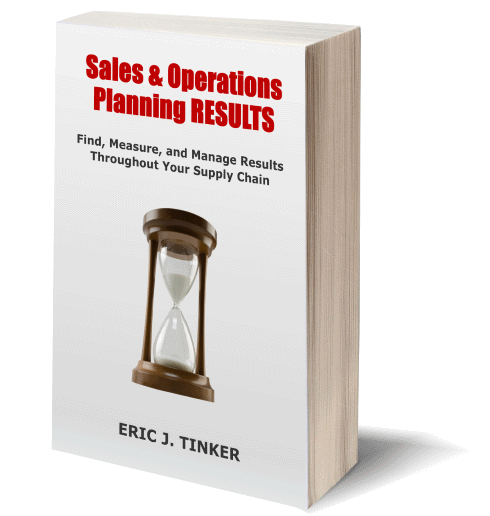
S&OP Jumpstart! is the most concise overview – if we’re in a discussion of any kind, use the contact form and we can send you a complimentary copy of the PDF version or see the graphic in the margin for the Amazon link (select countries that Amazon chooses, sorry)
S&OP Implementation Success – A longer, but skimmable ebook, It’s the basis for the next book in progress. Free on Nexview Online
Align Your Organization Around S&OP – free on Nexview Online
Directing Success – 10 Tips for S&OP Sponsors – free on Nexview Online
Other Blog Posts – Usually discuss an aspect of S&OP
We are a management consulting firm that specializes in Sales & Operations Planning and Supply Chain improvement. We leverage S&OP to be the platform for continuous improvement and profitability within client organizations. We also work with clients to improve organizational performance, structure, and enabling information technology. Consulting methods promote sustainability of performance improving behaviors, tangible results, and development of client team members. Our consultants are highly experienced business and consulting leaders with track records of delivering results for clients across the world, typically with larger well-known consulting firms. We are based in the Boston area, but travel worldwide to conduct training seminars, speak at conferences, and work with clients on high-impact, performance improving initiatives.
© Nexview Consulting, LLC ® | Terms & Conditions, Privacy
See how roles & responsibility definition in your organization compares.
Also receive an occasional email with helpful content, no spam we promise!